Pinned package consumption
Downstream products can consume world-runtime as a supported package and start it through the released CLI or module serve entrypoints.
world-runtime gives humans, software, and AI agents an explicit model of operating reality: durable state, append-only events, simulation before commitment, policy-governed action, and audit-ready replay.
The missing layer is the runtime between AI intent and real-world consequence. world-runtime coordinates state, events, policies, approvals, simulations, and operator control across enterprise decision systems.
Track entities, relationships, events, proposals, and decisions instead of treating every AI interaction as an isolated request.
Keep human review, rule evaluation, tool boundaries, and decision evidence inside the runtime itself by design.
Build multiple decision systems on one shared runtime instead of rebuilding the same governance layer for every workflow.
What is new in v1.1.0
The v1.1.0 release keeps the v1 App Server, Public API, SDK, persistence, and extension-contract posture intact while adding downstream-consumable managed runtime capabilities.
Downstream products can consume world-runtime as a supported package and start it through the released CLI or module serve entrypoints.
Local runtime-adjacent services can be described, supervised, health-checked, restarted, and inspected through validated service manifests.
Teams can map structured extraction, assistant, and related workloads to provider inventory with deterministic routing and bounded fallback.
Inventory, provider inspection, task resolution, and bounded reconcile are exposed through supported App Server, Public API, and SDK paths.
A local AI reference path shows schema-shaped extraction workloads validated through the released runtime management surfaces.
Why
AI can propose action faster than enterprises can govern consequence. Teams need explicit world state, policy, approvals, simulation, and replay between intent and commitment.
Build
Learn how to turn the runtime into concrete domains: supply networks, lab science, air traffic, power grids, city operations, markets, autonomous systems, and multi-agent coordination.
How
Works with your stack: keep your models, tools, services, and cloud choices, then use world-runtime to structure state, proposals, simulation, policy, approvals, and audit-ready replay.
Docs
Docs focuses the repo into usable paths: evaluator orientation, v1.1.0 release notes, consumer guidance, developer quickstarts, public APIs, operator playbooks, and extension contracts.
Repository
Explore world-runtime
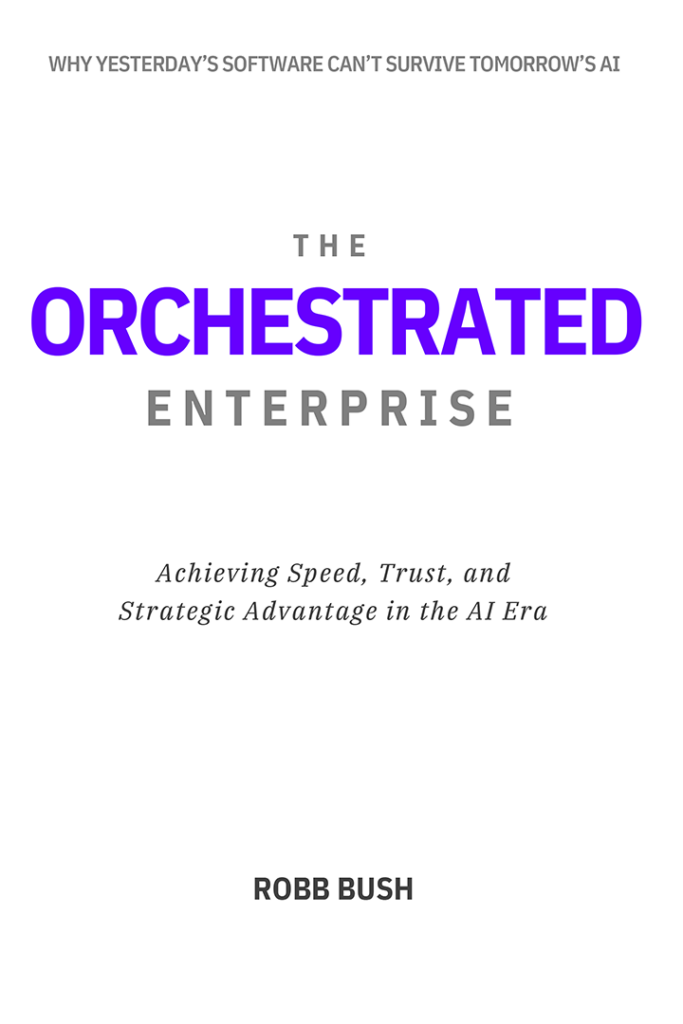
Further reading
Robb Bush lays out the business-strategy logic behind world-runtime: why coordination, trust, governance, and orchestration-native operating models matter more as intelligence becomes abundant.